
If you’re looking for the best spirulina supplements for women over 50, you’ve probably heard two opposite stories. One says this blue-green superfood fixes everything from anemia to cholesterol. The other says it’s a contaminated algae some doctors won’t touch. Both contain a piece of the truth, and neither tells the whole story. This guide gives you the honest middle: the centuries-old history, what the human studies really show, the safety question explained calmly, and the five products that hold up best.
NOW Foods Organic Spirulina 500 mg Tablets
Pure USDA Organic spirulina with no binders or fillers, from a long-established manufacturer with A-rated GMP certification, at one of the lowest prices per gram.
⏱️ The 30-Second Version
- What it is: a protein-rich cyanobacterium (often called blue-green algae) eaten for centuries in Mexico and Chad. It’s colored by phycocyanin, a blue pigment found in very few foods.
- What the studies show: possibly a small drop in diastolic blood pressure, and mixed results for cholesterol. Most trials are small and short.
- For women after menopause: a major review found no trials yet in postmenopausal women with metabolic syndrome, and no evidence for menopause symptoms.
- Not a reliable B12 source: most of the “B12” in spirulina is a form your body can’t use well.
- Safety comes down to quality: pure spirulina has a good safety record, but contamination is possible. Choose a reputable brand, and skip it if you have an autoimmune condition or PKU.
Maybe you’ve seen spirulina in a smoothie bowl or on a “superfood” list and wondered if it’s worth taking after 50. The answer depends on what you hope it will do. Let’s start with where it comes from, because it’s one of the best stories in the whole supplement aisle.
📋 What’s in This Guide
Two Civilizations, One Blue-Green Food
In Mexico, the Aztecs skimmed a blue-green mat from the surface of Lake Texcoco, the great lake around their capital, Tenochtitlán. They called it tecuitlatl, dried it into cakes and sold it in the markets. One of Hernán Cortés’s soldiers, Bernal Díaz del Castillo, described those cakes in his account of the conquest. After the Spanish drained the lakes, the food faded from daily life.
In Africa, on the shores of Lake Chad, the Kanembu people were harvesting the very same organism, drying it in the sun into cakes called dihé. They still eat it today.
Then science connected the dots. In 1940, the French scientist Pierre Dangeard described dihé as a dried cake of blue-green algae. In the mid-1960s, the Belgian botanist Jean Léonard confirmed it was spirulina, the same organism the Aztecs had eaten. Two civilizations, an ocean apart, had independently discovered the same food.
That history is real, and it’s worth honoring. But a food that nourished people for centuries isn’t automatically a medicine for women in 2026. That’s what the rest of this guide is about.
What Spirulina Actually Is
Spirulina (scientific name Arthrospira platensis or Arthrospira maxima) isn’t technically a plant or a true algae. It’s a cyanobacterium, a tiny organism that makes energy from sunlight. It grows naturally in warm, alkaline lakes and is farmed today in ponds and tanks around the world.
By dry weight it’s unusually rich in protein, and it also contains iron, beta-carotene and GLA (gamma-linolenic acid, a fatty acid). The catch is the serving size: a typical dose is a few grams, roughly a teaspoon, so the amount of any single nutrient you actually get is modest. A teaspoon of NOW’s powder, for example, provides about 2 grams of protein and 1.6 mg of iron.
The Compounds That Make Spirulina Blue-Green
Spirulina’s color is a clue to what makes it scientifically interesting. Like blueberries, carrots and leafy greens, it’s packed with natural pigments and protective compounds, called phytochemicals:
- Phycocyanin: spirulina’s signature. This brilliant blue pigment-protein is the most abundant protein in spirulina and is rare in the foods we normally eat. It’s the source of the “blue spirulina” used to color smoothies and candy. In the lab, it acts as an antioxidant and calms inflammatory signals.
- Chlorophyll: the green pigment that captures sunlight, the same one in spinach and kale.
- Carotenoids: including beta-carotene, the same orange pigment in carrots, which your body can turn into vitamin A.
EVIDENCE: MOSTLY LAB AND ANIMAL STUDIES
A 2024 scientific review of phycocyanin found encouraging antioxidant and anti-inflammatory effects in cells and animals, but no completed human trials of phycocyanin itself. And we’ve learned the hard way that a compound that works in a test tube doesn’t always help in a pill: when beta-carotene was given as high-dose supplements to people at high risk, mostly smokers, two large trials found more lung cancer, not less.
Curious why blue, green and orange plants protect your body in different ways? We explain the science simply in The Why Behind It, our series on the science behind what you eat and take.
What the Science Really Shows
Here’s what has actually been tested in people, with our evidence labels.
Cholesterol and triglycerides
EVIDENCE: MIXED
Earlier meta-analyses found that spirulina lowered LDL cholesterol and triglycerides at doses of at least 2 grams a day for 12 weeks or more, in studies mostly of people with existing health problems. But a 2025 meta-analysis of nine randomized trials found no significant effect on LDL, HDL or triglycerides, only a non-significant trend for total cholesterol. Our read: a possible modest effect in some people, not a reliable cholesterol treatment.
Blood pressure
EVIDENCE: SMALL EFFECT
The same 2025 meta-analysis found a small but significant drop in diastolic blood pressure (the bottom number), and no significant change in systolic pressure. The authors described the effect as small, of uncertain clinical importance, and something to complement treatment, not replace it.
Blood sugar
EVIDENCE: WEAK
Pooled studies suggest fasting blood sugar may fall by around 5 mg/dL, which is too small to matter much for most people. A few small trials in people with type 2 diabetes reported larger changes, but the results are inconsistent.
Anemia and immunity in older adults
EVIDENCE: ONE SMALL STUDY
In a 2011 study of 40 adults over 50 with a history of anemia (30 completed it), 3 grams a day of spirulina for 12 weeks was linked to rising hemoglobin per red cell and changes in some immune markers. The researchers reported that older women seemed to respond faster. But there was no placebo group, and the spirulina maker co-authored the study. It’s interesting, not proof.
Menopause
EVIDENCE: NOT YET STUDIED
A 2020 review in Marine Drugs looked at 20 human trials of spirulina and metabolic health, with postmenopausal women in mind. The authors found the results encouraging, but wrote that they “have not found any clinical trial” of spirulina in postmenopausal women with metabolic syndrome, and called for those trials to be done. Spirulina hasn’t been shown to help hot flashes or other menopause symptoms. For those, see our menopause supplements guide.
The B12 Myth
You’ll often read that spirulina is a great source of vitamin B12, even on supplement labels. It isn’t. Most of the B12 measured in spirulina is pseudovitamin B12, a look-alike form that your body can’t use well. Lab analyses have found that the large majority of spirulina’s “B12” is this inactive form.
Why this matters after 50
- B12 absorption naturally declines with age, and low B12 is common after 50.
- If you’re vegan or vegetarian, don’t count on spirulina for B12.
- Use a dedicated B12 supplement instead. See our B12 guide.
The Safety Question, Explained Calmly
This is the part most spirulina articles skip. Here’s the honest picture, from both sides.
The reassuring side. In 2011, the U.S. Pharmacopeia’s expert committee reviewed spirulina’s safety and gave it a Class A rating, meaning the evidence didn’t show a serious health risk when the product is properly made and used. In a 2014 lab study, BMAA, a nerve toxin linked to some blue-green algae, wasn’t detected in any of the 10 spirulina samples tested. The researchers called that reassuring but preliminary. And in a German study of 13 algae supplements, microcystins (liver toxins from other cyanobacteria) turned up only in products made from a different organism, Aphanizomenon flos-aquae, not in spirulina.
The cautious side. Spirulina itself doesn’t make these toxins, but it can be contaminated by other cyanobacteria or absorb heavy metals if it’s grown in polluted or poorly controlled water. Supplements aren’t approved by the FDA before they’re sold, so quality depends on the maker. Some doctors, including integrative physician Dr. Andrew Weil, advise against spirulina altogether for these reasons.
Skip spirulina, or ask your doctor first, if you:
- Have an autoimmune condition (such as rheumatoid arthritis, lupus or multiple sclerosis), or take medicine to suppress your immune system. Spirulina may stimulate the immune system.
- Have phenylketonuria (PKU). Spirulina contains phenylalanine.
- Take blood thinners. Spirulina may affect clotting.
- Have a history of allergic reactions to algae or seaweed. Rare but serious allergic reactions have been reported.
Do You Recognize Yourself?
Spirulina may be worth trying, after checking the safety notes above, if:
- You want an easy way to add a protein-rich green food to smoothies
- Your doctor has flagged slightly high blood pressure and you’re looking for small, supportive habits alongside your treatment
- You’re curious about phycocyanin and like the idea of adding more color to your diet
- You don’t have an autoimmune condition or PKU
What to Look for in a Spirulina Supplement
A reputable, established manufacturer. Quality control is the whole safety story for spirulina.
Testing you can ask about. The best brands test for heavy metals and microcystins and will share results. If a brand won’t answer, that’s an answer.
Pure spirulina. The label should say Arthrospira platensis or maxima, ideally with nothing else added.
A dose that matches research. Studies mostly used 1 to 8 grams a day. With 500 mg tablets, that means 2 to 16 tablets, so powder or larger tablets can be easier.
Organic is a plus, not a guarantee. Organic certification controls pesticides, but it doesn’t test for algae toxins.
Top 5 Best Spirulina Supplements for Women Over 50
We checked each product’s label for purity, dose, manufacturing standards, testing claims and price per gram, and compared them with a sample of spirulina listings on Amazon. Details come from each product’s listing at the time of writing. Brands do change formulas, so check the current label before you buy.
1. NOW Foods Organic Spirulina 500 mg Tablets — Best Overall
What we love:
- Pure organic Arthrospira platensis with no binders, excipients or additives, according to the label
- From NOW, a family-owned manufacturer since 1968 with A-rated GMP certification and accredited in-house labs
- One of the lowest prices per gram among the products we reviewed
- Small tablets that are easy to swallow
Worth noting: Reaching a research-level dose of 2 to 4 grams means 4 to 8 tablets a day. The listing doesn’t say whether batches are tested specifically for microcystins, so ask NOW if that matters to you.
2. Nutrex Hawaii Pure Hawaiian Spirulina 1,000 mg — Best Premium
What we love:
- Grown on a single farm in Kona, Hawaii, according to the brand
- Third-party tested and glyphosate residue free, according to its Amazon listing
- Larger 1,000 mg tablets, so a 3-gram serving is just three tablets
- Hawaiian spirulina from the same producer was used in the 2011 study in older adults described above
Worth noting: It isn’t certified organic, the tablets contain small amounts of added ingredients (silica, chicory inulin and magnesium stearate), and it costs several times more per gram than our top pick. The study connection is worth knowing, but that study had no placebo group and was co-authored by the producer.
3. NOW Foods Organic Spirulina Powder — Best for Smoothies
What we love:
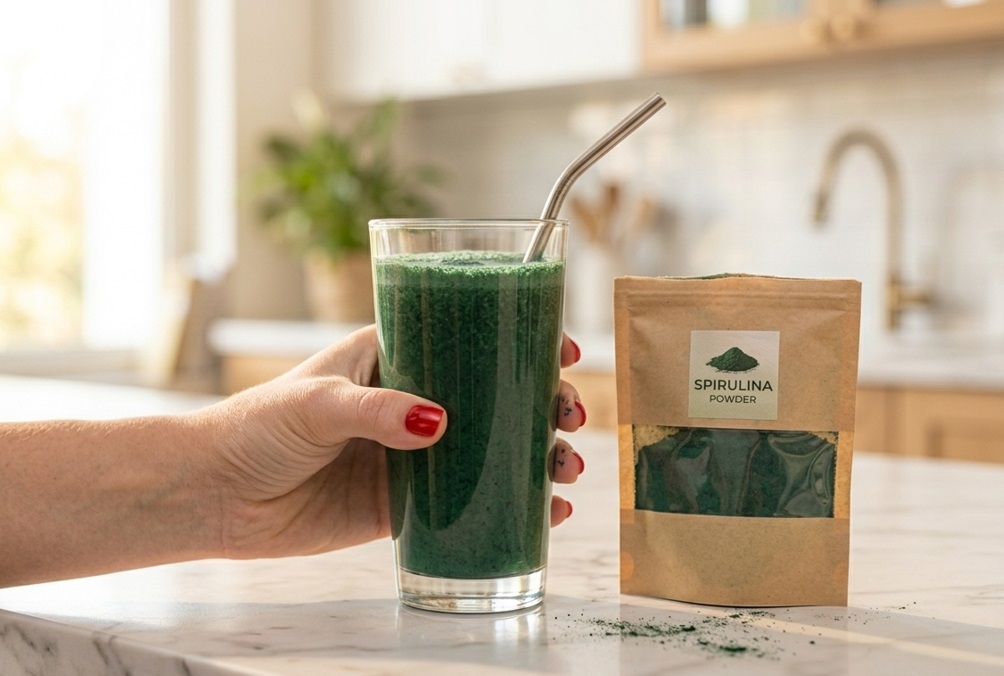
- One teaspoon gives you about 3 grams, right in the range used in studies
- Each teaspoon provides about 2 g of protein and 1.6 mg of iron
- The same NOW manufacturing standards as our top pick
- Very economical per gram in the 1-pound size
Worth noting: The listing calls spirulina “the highest known vegetable source of B-12,” but most of that B12 is an inactive form your body can’t use well (see “The B12 Myth” above). The taste is strong and “pond-like,” so blend it with banana, pineapple or berries.
4. BulkSupplements Organic Spirulina Powder — Best Budget Powder
What we love:
- One ingredient, with no fillers
- Third-party tested and made in a cGMP-compliant facility, according to the brand
- Large sizes keep the cost per gram very low
- A simple 3-gram serving that matches the research range
Worth noting: The listing gives less detail about where the spirulina is grown and what exactly is tested. If contamination is your main concern, ask for a certificate of analysis.
5. NOW Foods Organic Spirulina Double Strength 1,000 mg — Best for Fewer Tablets
What we love:
- Twice the spirulina per tablet as our top pick, so half as many tablets
- The same organic spirulina and NOW manufacturing standards
- Still affordable per gram
Worth noting: The larger tablets can be harder to swallow. If that’s a problem, the powder is easier.
Quick Comparison Table
| Product | Form | Per tablet / serving | Organic | For 3 g a day | Best For |
|---|---|---|---|---|---|
| NOW Organic Tablets | Tablet | 500 mg | Yes | 6 tablets | Best overall |
| Nutrex Hawaii | Tablet | 1,000 mg | No | 3 tablets | Premium, single farm |
| NOW Organic Powder | Powder | 3.3 g per tsp | Yes | 1 tsp | Smoothies |
| BulkSupplements Powder | Powder | 3 g per serving | Yes | 1 serving | Budget |
| NOW Double Strength | Tablet | 1,000 mg | Yes | 3 tablets | Fewer tablets |
Popular Products We Didn’t Pick (and Why)
- “Super greens” blends with spirulina: they usually contain only a small amount of spirulina among dozens of ingredients.
- Little-known brands with premium prices: some spirulina tablets sell for several times the price of established brands, with almost no track record.
- Spirulina sold as a B12 source: a red flag that the brand is repeating a myth.
- “Blue spirulina” for health: it’s mainly a food coloring extract (phycocyanin), with no human trials showing health benefits.
- Wild-harvested blue-green algae (AFA): a different organism from spirulina, and the one where microcystins have been found.
How to Take Spirulina
Start low. Begin with about 1 gram a day (two small tablets or a third of a teaspoon) and build up over two weeks. Spirulina can cause mild stomach upset or a “green” aftertaste at first.
Aim for the research range. Most studies used 1 to 8 grams a day, and the lipid benefits that have been seen appeared at 2 grams or more for at least 12 weeks.
Mix the powder well. Banana, pineapple, mango or berries hide the taste. Cold drinks help.
Give it time, then reassess. If you’re watching blood pressure or cholesterol, recheck with your doctor after about three months.
Frequently Asked Questions
What is the best spirulina supplement for women over 50?
For most women, NOW Foods Organic Spirulina tablets are the best value: pure, organic and from an established manufacturer. If you want a single-farm product and fewer tablets, Nutrex Hawaii is the premium option. For smoothies, NOW’s organic powder makes it easy to reach research-level doses.
Is spirulina safe?
Pure, properly made spirulina has a good safety record, and the U.S. Pharmacopeia gave it a Class A safety rating. The main risk is contamination with toxins from other cyanobacteria or heavy metals, which depends on the maker. Avoid it if you have an autoimmune condition or PKU, and ask your doctor if you take blood thinners.
Can spirulina help with menopause?
There’s no direct evidence. A 2020 review found no trials of spirulina in postmenopausal women with metabolic syndrome, and it hasn’t been shown to reduce hot flashes. It may have small effects on blood pressure, which tends to rise after menopause, but that’s not the same as treating menopause symptoms.
Is spirulina a good source of vitamin B12?
No. Most of the B12 measured in spirulina is pseudovitamin B12, a form your body can’t use well. If you need B12, which is common after 50, take a dedicated B12 supplement.
Does spirulina lower cholesterol?
It might, modestly. Older meta-analyses found drops in LDL and triglycerides, mostly in people with health problems taking at least 2 grams a day for 12 weeks or more. A 2025 meta-analysis found no significant effect on LDL, HDL or triglycerides. It’s no substitute for prescribed treatment.
Spirulina or chlorella: which is better?
They’re different organisms with different strengths. Spirulina is easier to digest and rich in phycocyanin. Chlorella needs a cracked cell wall and some chlorella products contain active B12, though the amount varies widely. See our chlorella guide for a full comparison.
Why does Dr. Andrew Weil say no to spirulina?
He has written that he advises against spirulina because blue-green algae can be contaminated with heavy metals and toxins such as microcystins and BMAA, and because there are cheaper sources of protein. Those risks are real but mainly depend on product quality. Testing of commercial spirulina has so far been reassuring, though limited.
How long does spirulina take to work?
Studies usually ran 8 to 16 weeks. You won’t “feel” most of the possible effects, like a small change in blood pressure, so the only way to know is to check your numbers with your doctor after a few months.
📚 Where We Got Our Information
Every health claim in this article is backed by a real source. Here’s exactly where our information comes from (and how we choose sources):
Final Verdict
Spirulina is a food with a remarkable past: eaten by the Aztecs, still eaten on the shores of Lake Chad, and colored by a blue pigment found almost nowhere else on your plate. As a supplement, its proven benefits are smaller than the hype: possibly a slight drop in blood pressure and mixed results for cholesterol, with no direct research yet in women after menopause. And it isn’t a B12 source.
For the best overall choice, NOW Foods Organic Spirulina Tablets give you pure, organic spirulina from a manufacturer with strong standards, at a fair price.
For a premium, single-farm option with fewer tablets, choose Nutrex Hawaii.
For smoothies, NOW Organic Spirulina Powder makes research-level doses easy, and BulkSupplements is the budget powder.
If you want fewer tablets from NOW, the Double Strength version halves your pill count.
Whichever you choose, buy from a brand you trust, skip it if you have an autoimmune condition or PKU, and enjoy it as one more color in a varied, plant-rich diet. That’s the honest way to welcome this ancient food into your life. ❤️