
You bought a vitamin K2 supplement — or a calcium formula that includes K2 — and felt good about it. Then you noticed the fine print: one says MK-4, another says MK-7, and a third just says “K2” with no number at all. Are they the same? Does the number matter? And what on earth is MK-9?
Here’s the honest truth almost no supplement label explains: the form of vitamin K2 you take genuinely matters — especially for bone and heart health after 50. This is the complete, plain-English guide to the menaquinones, so you can finally read a K2 label and know exactly what you’re getting.
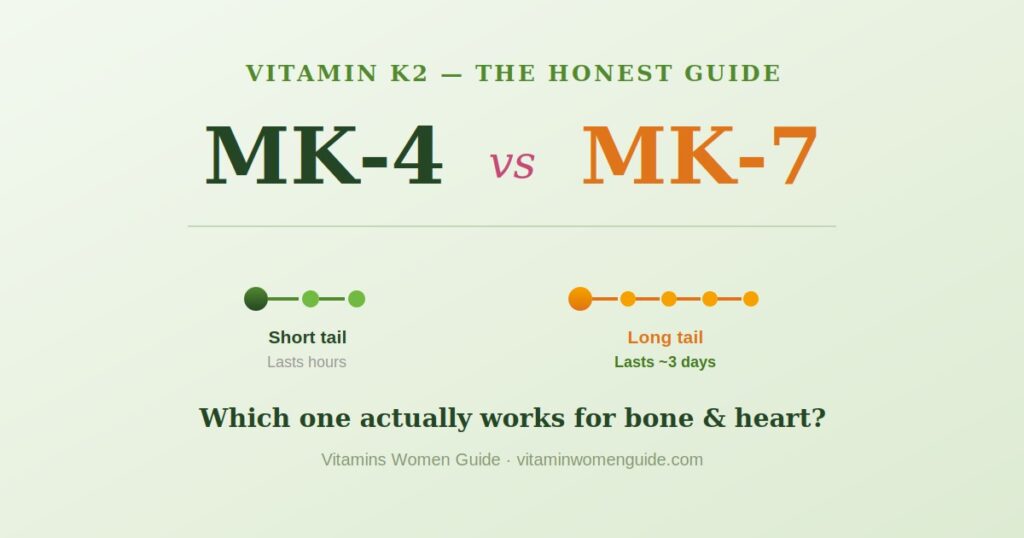
Vitamin K2 comes in several forms called menaquinones (abbreviated MK-4 through MK-13). The two you’ll see on supplements are MK-4 and MK-7. For most women over 50 — for bone density and keeping calcium out of your arteries — MK-7 is the better-researched choice, because it stays in your body far longer and works at a smaller daily dose. MK-4 isn’t useless, but it’s cleared from your blood within hours, while MK-7 lasts for days.
📋 What’s in This Guide
The Vitamin K Family, Explained Simply
“Vitamin K” isn’t one thing — it’s a family. And the family splits into two main branches:
Vitamin K1 (phylloquinone). This is the form in leafy green vegetables (kale, spinach, broccoli). Its main job is blood clotting. Your body absorbs only about 10–15% of it from plants, and it stays mostly in the liver.
Vitamin K2 (the menaquinones). This is the branch that matters for your bones and arteries. Instead of just clotting, K2’s special talent is calcium management — it activates proteins that pull calcium into your bones and keep it out of your blood vessels. K2 is made by bacteria (fermentation) and found in fermented foods and some animal products.
Within K2, there isn’t just one molecule. There’s a whole series, named by the length of their “tail” (a chain of isoprene units). That’s what the number means: MK-4 has a tail of 4 units, MK-7 has 7, MK-9 has 9, and so on — up to about MK-13. The length of that tail changes everything about how the vitamin behaves in your body.
MK-4 vs MK-7 — The Key Difference
These are the two forms you’ll actually see on supplement labels, so this is the comparison that matters most.
MK-4 — fast but fleeting
MK-4 is the short-chain form. It’s the type of K2 found in animal products (egg yolks, butter, meat, liver) and it’s the most common K2 form in a typical Western diet. Your body can also make a little MK-4 by converting vitamin K1. The catch: MK-4 has a very short half-life — a matter of hours. It’s absorbed and then cleared from your blood quickly, which limits how well it reaches tissues outside the liver, like your bones and arteries. That’s why studies using MK-4 typically use very high, multiple-times-a-day doses.
MK-7 — slow and steady
MK-7 is the long-chain form, produced by bacteria during fermentation (most famously in natto, a Japanese fermented soybean food). Its longer tail gives it dramatically better pharmacokinetics: MK-7 has a half-life of roughly 3 days, stays in your bloodstream far longer, and reaches your bones and blood vessels more consistently. Research shows it’s about 2.5 times more available over 24 hours and up to 6 times more available over 96 hours than K1 — and far more sustained than MK-4. Crucially, most of the clinical trials that showed improved bone mineral density and reduced arterial calcification used MK-7, at doses around 180–200 mcg per day.
MK-8, MK-9 and the Others — Where They Come From
You asked the question most people never think to ask: if there’s MK-4 and MK-7, what about the numbers in between and beyond? Here’s the honest, if lesser-known, picture.
The longer-chain menaquinones — MK-8, MK-9, MK-10 and up — are also produced by bacterial fermentation, and they turn up mostly in fermented foods, especially aged cheeses (think Gouda, Edam, and other hard cheeses) and other fermented products like sauerkraut and certain curds. MK-9 in particular is common in cheese.
Scientists have measured a whole spread of these in different cheeses — MK-4 through MK-10 all show up, in amounts that vary enormously from one cheese to the next depending on the bacterial cultures, ripening, and fat content. So your wedge of aged Gouda is genuinely a small, natural cocktail of several menaquinones.
But here’s the honest limit: while MK-8, MK-9 and MK-10 are real and present in food, the human research on them is far thinner than on MK-7. Regulatory bodies like EFSA have even said our knowledge of these longer menaquinones in food — and how well we absorb them — is too limited to set formal recommendations. They’re a fascinating part of a varied, fermented-food diet, but they’re not what supplement makers can meaningfully standardize or what the clinical bone trials relied on. For a supplement, MK-7 remains the practical, best-studied choice. For food, a diverse diet including some aged cheese and fermented foods naturally delivers a mix.
| Form | Where it comes from | Half-life | Best known for |
|---|---|---|---|
| MK-4 | Animal foods (egg yolk, butter, meat, liver); made from K1 | Hours (short) | Common in Western diets; needs high/frequent doses |
| MK-7 | Fermented foods (natto especially); supplements | ~3 days (long) | The bone & artery research; the supplement “gold standard” |
| MK-8 | Aged cheeses, fermented foods | Longer | Present in cheese; limited human research |
| MK-9 | Aged cheeses (Gouda, Edam), fermented dairy | Longer | Common in cheese; limited human research |
| MK-10 to MK-13 | Various fermented foods, gut bacteria | Longer | Minor dietary players; little studied |
The Best Food Sources of K2
Before you reach for a supplement, know that food can contribute meaningfully — and deliciously:
- Natto — fermented soybeans, and by far the richest natural source of MK-7 (roughly 850–1,100 mcg per 100g). An acquired taste for many Westerners, but unmatched
- Aged hard cheeses — Gouda and Edam offer a natural mix of menaquinones (around 75 mcg per 100g), softer cheeses like Brie somewhat less
- Egg yolks, grass-fed butter, liver, and meat — provide MK-4
- Sauerkraut, kimchi, miso — smaller amounts of longer-chain menaquinones from fermentation
The honest reality: unless you eat natto, it’s hard to get therapeutic MK-7 levels from food alone. This is exactly why K2 supplements — and calcium formulas that include K2 — exist.
Looking for calcium with the right K2?
See our honest, science-backed picks — with clear notes on which form of K2 each one uses.
How to Choose a K2 Supplement
Look for “MK-7” specifically. If bone density and cardiovascular support are your goals, the label should say menaquinone-7 or MK-7 — not just “K2.”
A sensible dose is 90–200 mcg. Most clinical benefit was seen around 180–200 mcg/day of MK-7. You don’t need mega-doses.
Pair it with vitamin D3. D3 and K2 work as a team — D3 helps you absorb calcium, K2 directs it to your bones. Many quality formulas combine them.
Take it with a fatty meal. K2 is fat-soluble, so a little dietary fat dramatically improves absorption.
Check with your doctor if you take blood thinners. This is essential: vitamin K interacts with warfarin (Coumarin) and similar anticoagulants. If you’re on a blood thinner, do not start K2 without medical guidance.
One Detail Even Fewer Labels Mention: All-Trans
Here’s a genuinely advanced point that separates quality MK-7 from cheap MK-7 — and almost no consumer guide mentions it. MK-7 molecules exist in two shapes, called cis and trans isomers. Only the all-trans form is biologically active in your body; the cis form does essentially nothing.
Cheaply chemically-synthesized MK-7 can contain a mix of both, meaning some of what you paid for is inert. Higher-quality MK-7 — especially that produced by natural fermentation, or clearly labeled “all-trans” — gives you more of the active form. If a supplement specifies all-trans MK-7, that’s a genuine quality signal worth paying a little more for.
Frequently Asked Questions
Is MK-7 really better than MK-4?
For bone and heart support in most people, yes — MK-7 has a far longer half-life (days vs hours), better bioavailability, and it’s the form used in most of the bone-density and artery studies. MK-4 has legitimate uses and is common in food, but for a once-daily supplement aimed at bones and arteries, MK-7 is the more evidence-backed choice.
What does the “MK” number actually mean?
It’s the length of the molecule’s tail — the number of isoprene units. MK-4 has four, MK-7 has seven, MK-9 has nine, and so on. Longer tails generally mean the vitamin lasts longer in your body and reaches tissues like bone and arteries more effectively.
Can I just eat cheese instead of taking a supplement?
Aged cheeses (Gouda, Edam) do provide a natural mix of menaquinones including MK-8 and MK-9, and they’re a lovely part of a varied diet. But the amounts and absorption vary a lot, and only natto reliably delivers high MK-7. Food helps; for consistent therapeutic levels, a supplement is more dependable.
How much K2 should I take?
Clinical benefits for bone and artery health were generally seen at 180–200 mcg/day of MK-7, though products range from 90–200 mcg. Take it with a meal containing some fat, and always check with your doctor first if you take a blood thinner.
Does K2 work without vitamin D?
They’re best together. Vitamin D3 helps your body absorb calcium; K2 helps direct that calcium into bone and away from arteries. Taking calcium with both D3 and K2 reflects the current understanding of how to support bone health while protecting the heart.
Other Guides You May Find Helpful
- Best Calcium Supplements for Women Over 50 — and the honest truth about calcium and heart health
- Best Vitamin D Supplements for Women Over 50 — K2’s essential partner
- Best Magnesium Supplements for Women Over 50 — the third piece of the bone-health puzzle
- The Why Behind It — the science behind what you take, explained simply
We’ve distinguished strong human evidence (MK-7) from the more limited research on longer menaquinones. Verify any of it:
The Bottom Line
Vitamin K2 isn’t one nutrient — it’s a family of menaquinones, and the number on the label genuinely matters. For women over 50 pairing K2 with calcium and vitamin D for stronger bones and healthier arteries, the honest, evidence-based answer is MK-7: it lasts for days rather than hours, works at a sensible once-daily dose, and it’s the form the bone-and-artery research actually used. MK-4 has its place, and the longer menaquinones (MK-8, MK-9) are a delicious footnote in aged cheese — but for a supplement with a purpose, MK-7 is the one to look for. Bonus points if it says all-trans.
Now you can read any K2 label and know exactly what you’re holding. That’s the whole point of this site: the real story, clearly told, so the choice is genuinely yours. 🌿
This article is educational and is not medical advice. It does not diagnose, treat, or prescribe. Vitamin K interacts with blood-thinning medications (like warfarin) — do not start a K2 supplement without talking to your doctor if you take an anticoagulant, or before starting any supplement if you have a health condition. As an Amazon Associate we earn from qualifying purchases; this never changes what we recommend or what we tell you. Vitamins Women Guide is an independent editorial project — researchers and writers, not doctors.