
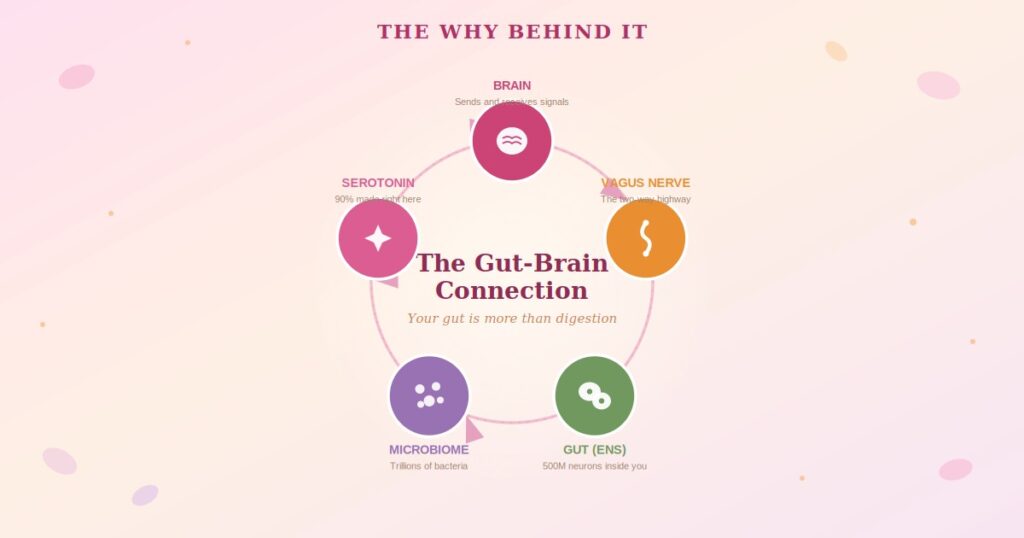
Most of us think of the gut the way we think of a drain — something that quietly processes what goes in and disposes of what’s left. A best-selling book changed that conversation for millions of readers: Gut, by German scientist Giulia Enders, became an international phenomenon by making the case that this organ deserves far more respect (and curiosity) than we give it.
She was onto something real. Your gut isn’t a drain. It’s home to its own independent nervous system — one so extensive and so busy that neuroscientists genuinely call it your “second brain.” And understanding it changes how you think about probiotics, mood, and the mysterious link between “gut feelings” and how you actually feel.
📋 What’s in This Guide
Your Gut Has Its Own Nervous System
Here’s the fact that surprises almost everyone: your digestive tract contains its own dedicated nervous system, called the enteric nervous system (ENS). It’s not a metaphor — it’s real neural tissue, embedded in the walls of your gut from esophagus to rectum, containing somewhere between 100 million and 500 million neurons depending on how it’s measured.
For comparison, that’s more neurons than you have in your entire spinal cord. The ENS can sense, coordinate, and control digestion — moving food along, adjusting blood flow, managing secretions — almost entirely on its own, without instructions from your brain. That’s why it earned the nickname “second brain” in neuroscience literature decades ago, long before it became a popular science bestseller.
Why 90% of Your Serotonin Is Made in Your Gut
Serotonin is best known as a mood-regulating brain chemical — it’s the target of most common antidepressants. So here’s the fact that catches people off guard: roughly 90% of the body’s serotonin is produced in the gut, not the brain, by specialized cells called enterochromaffin cells lining your intestinal wall.
Gut serotonin’s primary job is local — it helps coordinate digestion and movement through your intestines. But research increasingly shows it doesn’t stay local. Gut-derived serotonin activates nerve fibers that signal up through the vagus nerve to brain regions involved in mood and stress regulation. Your gut bacteria play a direct role here too: certain bacterial metabolites called short-chain fatty acids (SCFAs) — produced when gut bacteria ferment fiber — have been shown to boost the enzyme your gut uses to make serotonin in the first place.
The Vagus Nerve — The Phone Line Between Gut and Brain
If the gut and brain are having a two-way conversation, the vagus nerve is the main phone line. It’s the longest nerve of the autonomic nervous system, running from your brainstem down through your neck and chest into your abdomen, connecting directly to your gut.
Research shows this communication runs in both directions — and surprisingly, the majority of vagus nerve fibers carry information upward, from gut to brain, not the other way around. Your gut is talking to your brain more than your brain is talking to your gut. Signals about inflammation, stretching, and — as researchers are increasingly finding — the state of your gut microbiome all travel this route, influencing mood, stress response, and even cognitive function.
This is genuinely one of the most active areas in neuroscience and psychiatry research right now. Multiple 2024–2025 reviews describe dysbiosis (an imbalanced gut microbiome) as a contributing factor being studied in mood disorders including anxiety and depression — not a proven cause, but a genuinely active and promising area of investigation.
What the Different Probiotic Strains Actually Do
This is where the gut-brain science becomes genuinely practical — and it connects directly to something we cover in our best probiotics guide: not all bacterial strains do the same job. Think of your gut microbiome like a large staff with different specialists, each suited to a different task.
| Strain family | Where it’s mainly studied | What it’s linked to |
|---|---|---|
| Lactobacillus rhamnosus | Gut & vaginal microbiome | One of the most-studied strains; vaginal pH support, general gut health |
| Lactobacillus crispatus, jensenii, gasseri | Vaginal microbiome | Dominant species in a healthy vaginal ecosystem |
| Bifidobacterium longum | Gut-brain axis research | Studied for its connection to stress response and relaxation |
| Bifidobacterium 35624 | Digestive comfort | Extensively studied specifically for occasional bloating and gas |
| Lactobacillus reuteri, fermentum | Vaginal & digestive health | Support for vaginal pH balance in clinical research |
This is why we’ve moved away from judging a probiotic by the giant “CFU” number on the front of the bottle. The strain — the specific, named species and code — is what determines what that bacteria actually does in your body. A probiotic loaded with billions of the wrong strain for your goal is a bit like hiring a huge team of extremely enthusiastic people who don’t have the skill you actually need.
The Honest Limits of Gut-Brain Science
In the spirit of giving you the whole picture, not just the exciting part: gut-brain research is genuinely promising, but it’s also genuinely young. Here’s what we want you to know:
- Most of the strongest evidence for specific strains comes from digestive or vaginal health outcomes — the mood and cognition research, while active and exciting, is earlier-stage
- A healthy gut microbiome is not a substitute for treatment of clinical depression or anxiety — if you’re struggling, please talk to a doctor or therapist
- “Gut healing” products that promise to fix mood, weight, and immunity all at once with vague ingredient lists deserve real skepticism
- The most reliable, evidence-backed levers you have are the boring ones: fiber-rich food (which feeds beneficial bacteria), adequate sleep, stress management, and — when relevant — a probiotic with a specific, named strain matched to your actual goal
Want strain-specific picks?
See our honest, science-backed guide to which probiotic strains actually match your goals.
Frequently Asked Questions
Is the “second brain” a real scientific term, or just a popular science phrase?
It’s a real, established term in neuroscience for the enteric nervous system — used in scientific literature for decades before it became popularized. The ENS genuinely contains hundreds of millions of neurons and can function independently of the brain to coordinate digestion.
Can taking probiotics improve my mood?
The gut-brain connection is real, and specific strains (like certain Bifidobacterium longum strains) have been studied for stress and relaxation. But the evidence for probiotics as a mood treatment is still early-stage compared to the stronger evidence for digestive and vaginal health strains. Think of it as a promising, developing area — not a proven mood fix.
Why does stress affect my digestion so much?
Because the gut-brain axis runs both ways. Stress signals from your brain travel down the vagus nerve and through hormonal pathways to your gut, which is why anxiety so often shows up as stomach upset, appetite changes, or altered gut motility — it’s not “in your head,” it’s a real, physical communication loop.
Do I need a probiotic supplement, or can food do this?
Fiber-rich foods (vegetables, legumes, whole grains) feed your existing beneficial bacteria and are genuinely foundational. A targeted probiotic supplement makes the most sense when you have a specific goal — like vaginal health or occasional bloating — where a particular studied strain applies.
Other Guides You May Find Helpful
- Best Probiotics for Women Over 50 — strain-specific picks for your actual goals
- Best Menopause Supplements for Women Over 50 — what genuinely helps mood and sleep
- The Why Behind It — more of the science behind what you take, explained simply
We reference Giulia Enders’ bestselling book Gut as the cultural moment that brought this topic into the mainstream — but the science below is drawn from peer-reviewed research, not the book itself:
This article is educational and is not medical advice. It does not diagnose, treat, or prescribe. If you’re experiencing persistent digestive issues, anxiety, or depression, please talk with a doctor or mental health professional. Vitamins Women Guide is an independent editorial project — we’re researchers and writers, not doctors.